New Florida Law: Pay Subcontractors and Suppliers Within 45 Days or Risk Your License
A July 1, 2026 Florida statute puts a contractor's license at risk for withholding payment from subcontractors.
Since July 1, 2026, a licensed contractor that knowingly or willfully withholds payment from a subcontractor or supplier can face discipline against its license. Here is what the new statute says and what it leaves open.
Until this year, an unpaid subcontractor or supplier on a private Florida job had mostly the familiar tools: liens, bond claims, and lawsuits. A new statute adds pressure of a different kind, aimed at the contractor’s license. Senate Bill 290, signed March 23, 2026 and effective July 1, 2026 as chapter 2026-3, Laws of Florida, created section 489.1295, Florida Statutes, titled “Prohibition against nonpayment.”
What the Statute Requires
The new section requires a licensed contractor to pay its subcontractors and suppliers within 45 days after the contractor itself is paid for their work or materials, or on the schedule the contract sets, unless the amount owed is the subject of a bona fide dispute. Subcontractor and supplier carry the meanings given in section 558.002, the definitions section of Florida’s construction defect statute. A knowing or willful violation exposes the contractor to discipline under section 489.129, where the available penalties include fines of up to $10,000 per violation and, at the far end, suspension or revocation of the license. Nothing in the text limits the requirement to public projects, so it reaches private commercial and residential work as well. Because the section sits in the part of chapter 489 that governs contractors licensed through the Construction Industry Licensing Board, whether it also reaches electrical and alarm system contractors, who are licensed under a separate part of the chapter, is an open question.
When the 45 Days Start
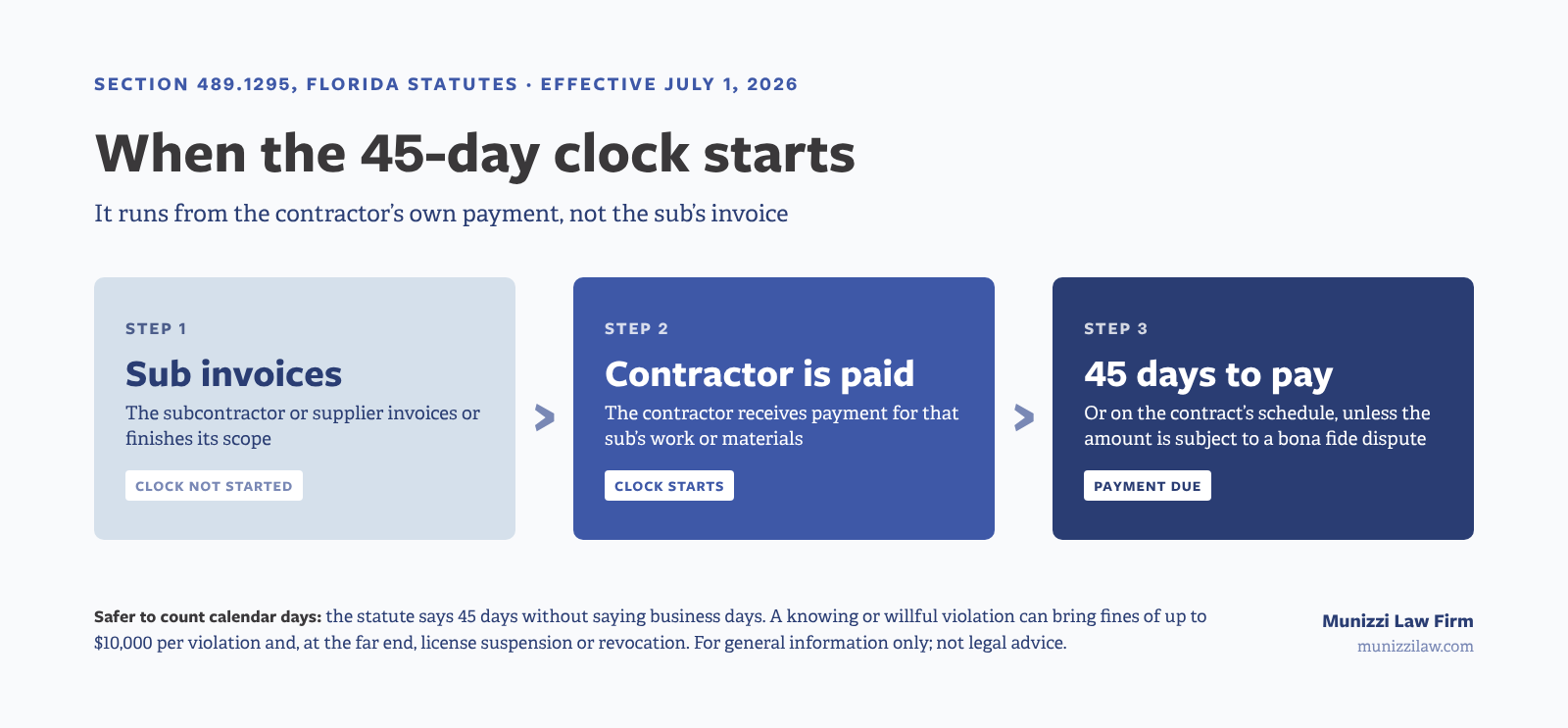
The clock does not start when the subcontractor invoices or finishes its scope. It starts when the contractor receives payment for the services or materials that subcontractor or supplier provided, so a contractor that has not yet been paid for that work is not in violation of the 45-day measure. The statute says 45 days without saying business days, and the safer course is to treat it as 45 calendar days. Because the statute also allows payment in accordance with the contract, a subcontract that sets its own payment schedule matters more than it used to, although the statute does not say which measure controls when the contract and the 45-day period point to different dates.
Pay-If-Paid Clauses and Bona Fide Disputes
We do not read the new section as overriding a correctly drafted pay-if-paid clause, which shifts the risk of owner nonpayment to the subcontractor, because the 45 days run from the contractor’s own receipt of payment and the statute expressly allows payment on the contract’s terms. The exception for a bona fide dispute is where most of the fighting will happen. The statute does not define the phrase, but a dispute invented to justify holding money will not look bona fide to a licensing board, and a real disagreement over one line item does not obviously justify holding the rest of the invoice. A contractor that withholds should put the reason in writing at the time, tie it to the contract, and release whatever portion is not genuinely contested.
What It Changes in Practice
For subcontractors and suppliers, the statute adds a licensing complaint to the usual tools, and the prospect of a complaint against the contractor’s license can move a payment conversation in a way a lien sometimes does not. It does not replace notices to owner, lien deadlines, or bond claims, which still have to be preserved on their own schedules. For contractors, the statute is a reason to review subcontract and purchase order payment terms, to make sure accounts payable releases funds within 45 days of receiving them unless a documented dispute exists, and to have project managers document disputes when they arise rather than reconstructing them after a complaint is filed. We draft and review subcontracts and purchase order terms for Florida contractors and suppliers, and we can help either side sort out where it stands on a particular payment.
This article is for general informational purposes only and is not legal advice. It reflects the statute as of publication, before any guidance from the Construction Industry Licensing Board or the courts on how it will be applied. Reading it does not create an attorney-client relationship.