SBA’s New Acquisition Rules: What Changed October 1 for Buyers, Sellers, and Seller Notes
New SBA rules for loans approved on or after 10/1/2026 change equity injection, seller notes, and seller transitions.
SBA loans approved on or after October 1, 2026 follow rewritten change-of-ownership rules, on top of the citizenship requirement that took effect in March. Here is what buyers, sellers, and the brokers who bring them together need to know.
Many of the small business sales we work on are financed with SBA 7(a) loans, and two SBA changes this year alter how those deals have to be built. The first, which applies to loans numbered on or after March 1, 2026, limits SBA financing to businesses owned entirely by U.S. citizens or U.S. nationals. The second is SOP 50 10 8.1, the SBA’s updated lending rulebook, which took effect October 1, 2026 and consolidates the rules for change-of-ownership loans in Appendix 15. Together they affect how much cash a buyer has to bring, how much of the price a seller can carry, how long a seller can stay involved, and in some cases whether a deal can use SBA financing at all.
The Citizenship and Residency Rule
Under the rule that took effect March 1, which the new SOP carries forward, every direct and indirect owner of the borrowing business, and every guarantor the SBA requires, must be a U.S. citizen or U.S. national whose principal residence is in the United States or its territories or possessions, and any entity in the ownership chain must be organized in the United States, its territories, or possessions. Lawful permanent residents are now treated as ineligible, whether their green cards are conditional or permanent. The rule also looks back six months: if an ineligible person owned any part of the borrower at any point in the six months before the SBA loan number issues, the business cannot qualify unless that person has given up every bit of the interest before the loan number issues. A buyer who holds a green card, or a buyer group that includes one, can no longer own any piece of an SBA-financed acquisition, and that has to be identified before anyone signs a letter of intent.
Why Deal Structure Matters More Now
The lookback creates a trap in stock purchases and partial buyouts that is easy to miss. In those deals the company being sold is typically the borrower or a co-borrower, and the seller still owns it when the loan number is issued. Read literally, if the seller is not a U.S. citizen or national, the company is ineligible until the seller is completely out, which is hard to arrange when the seller’s exit is the very thing the loan is meant to fund. In a typical asset purchase, by contrast, the borrower is a new entity owned by the buyer, so the seller’s status does not affect the borrower’s eligibility in the same way. The SOP does not address that situation directly, so this is our reading rather than settled SBA guidance, and it is one more reason to choose between an asset purchase and a stock purchase with the financing in mind, before the lender raises the issue.
Equity Injection and Seller Notes
Appendix 15 sorts every acquisition into one of four categories: an initial acquisition, an expansion by an existing business in the same industry, a buyout of one owner by another, or an ESOP or cooperative transaction. An initial acquisition is the default, and it covers most purchases by a buyer who was not already an owner. In an initial acquisition, the buyer’s equity must equal at least 10 percent of total project costs, and the lender cannot reduce or waive it. Seller financing, standby debt, and money from passive minority investors can together supply no more than half of that amount, so a buyer whose project costs total $1,000,000 would have to inject at least $100,000, and no more than $50,000 of it could come from those sources.
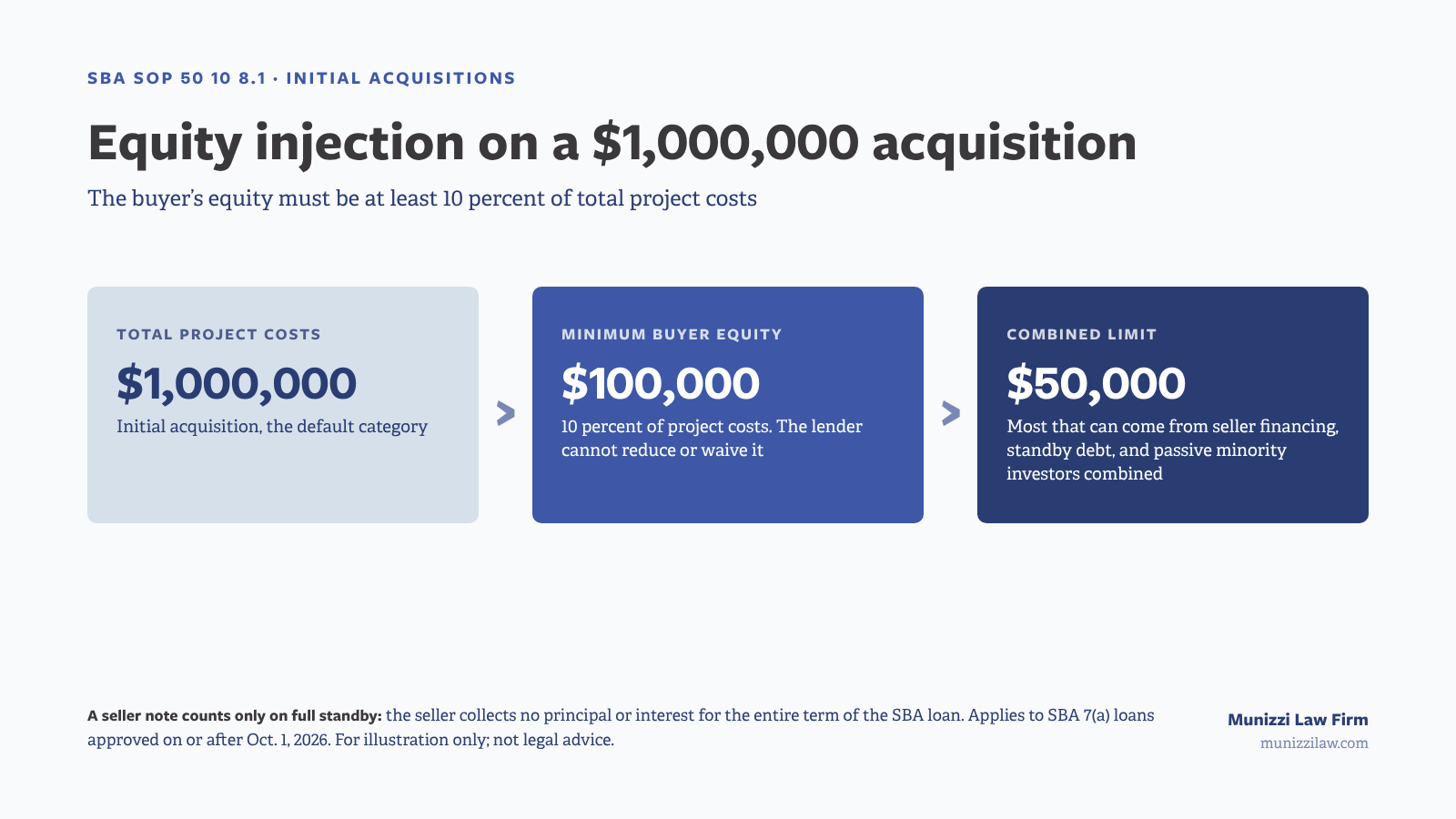
A seller note counts toward the buyer’s equity only if it sits behind the lender’s loan and is on full standby, which means the seller collects nothing, neither principal nor interest, for the entire term of the SBA loan, and the business portion of an acquisition loan can run as long as 10 years. A seller note that pays on a regular schedule is still allowed, but it counts as debt the business’s cash flow has to support, and total debt for the purchase cannot exceed the value of the business as determined by the required business valuation. If the price is higher than that value, the buyer has to make up the difference with equity. Sellers should understand these terms before agreeing to carry part of the price, because they determine how long the seller waits to be paid and how much risk the seller is actually taking.
Seller Transitions, Partial Buyouts, and Cash Flow
In an initial acquisition or an expansion, a seller who sells the entire business cannot keep an ownership stake or remain an officer, director, or employee. If the buyer needs help with the handoff, the business can hire the seller as a consultant for up to 24 months in total, including any extensions, which leaves room to build a genuine transition of customer and vendor relationships into the deal. Owner buyouts follow different rules: at least one of the original owners generally has to remain an owner and guarantee the loan, and a buyer who has not been employed by the business for at least the past 24 months can acquire less than half of it and cannot become its largest owner unless the deal is underwritten to the stricter standards for an initial acquisition. A selling owner who keeps less than 20 percent after a partial buyout must still guarantee the full loan for at least two years after the final disbursement.
In every category, repayment has to be shown from the business’s results for the last fiscal year or the average of the last two, with any adjustments documented and justified by the lender, at 1.25 times debt service (1.15 for an expansion), and outside a narrow exception for special-purpose properties such as hotels, projections cannot be used to meet that test. When the price of an initial acquisition or expansion reaches $3,000,000, excluding owner-occupied real estate, the lender also needs a quality of earnings report, and earnouts payable to the seller are not allowed in any purchase financed with a 7(a) loan. The practical effect is that the price has to be justified by what the business has already earned, and a seller who expects to be paid for growth that has not happened yet will have a harder time getting that value financed with an SBA loan. 7(a) Small and SBA Express loans can still finance a change of ownership, but they follow the same appendix, including its equity and cash flow requirements.
What to Do Now
Deals already in the pipeline deserve a second look, because the new rules apply to loans approved and assigned an SBA loan number on or after October 1, no matter when the letter of intent was signed. Buyers should confirm the citizenship and residency of every owner and guarantor at the outset; sellers should learn early whether the lender will count a seller note toward the buyer’s equity and what full standby would mean for them; and both sides should make sure the price, the transition arrangement, and any partial buyout structure match what the lender can approve. Business brokers who raise these points in the first conversation will spare their clients a renegotiation later. We represent buyers and sellers in SBA-financed acquisitions and can review a letter of intent or deal structure before it goes to the lender.
This article is for general informational purposes only and is not legal advice. It reflects SBA rules as of publication, which change often. Reading it does not create an attorney-client relationship.